The direct answer
Online personal training can work for over-50s — and for the right client, it works as well as in-person coaching. The catch is that the programme has to be designed for an over-50 body, not retrofitted from a younger-client template. Most online subscription apps fail over-50 clients because they ignore the three things that actually matter: limited recovery capacity, the desk-job movement pattern, and the unpredictable schedule of senior professional life. Structured online coaching that respects all three produces measurable results across 6 to 12 months. Generic app subscriptions, for this audience, are largely a waste of money.
Who online coaching is right for
Three client patterns benefit most from the online format:
1. The frequent traveller. Two or more weeks a month on the road. In-person coaching breaks down because the patient is never at the gym; structured online programming adapts to whichever hotel gym, bodyweight session, or home setup is available on any given week. The same programme block runs across the travel pattern; the format flexes around it.
2. The unpredictable schedule. Most senior professionals can train consistently somewhere in the week, but cannot reliably train at a fixed time. Online coaching with weekly check-ins suits this — the patient trains when they can, the data is reviewed weekly, the programme adapts.
3. The structured-autonomy preference. Some clients are deeply self-motivated, well-read, and want a structured programme + monthly review rather than ongoing 1-to-1 oversight. Online coaching is exactly this format. It costs less than 1-to-1, suits clients who don’t want or need hands-on coaching, and produces strong results for those who are disciplined about following the programme as written.
Who online coaching is not right for
Three patient patterns are better served by in-person coaching:
1. Patients with significant technique gaps. A patient who has never lifted seriously needs hands-on cueing to build movement competence. Online coaching can support the maintenance of technique once it’s built, but the build-from-zero phase is much faster in person. Many clients start with 6 to 12 in-person sessions, then transition online once the patterns are established.
2. Returning-from-injury clients. Post-surgical or post-significant-rehab clients benefit from in-person sessions for the first 8 to 12 weeks — the close supervision catches compensation patterns that video can miss. Online coaching is appropriate after the rehab phase is complete.
3. Patients who train infrequently. If you train once a week, each session matters disproportionately and the in-person feedback per session is worth the cost difference. Online coaching is better value when training 2 to 3 times per week.
What an over-50 programme has to do differently
The single biggest failure mode of generic online programmes for over-50 clients: treating recovery capacity as unlimited. A typical 25-year-old can recover from a hard training session in 24 hours. A 50-year-old with a 60-hour week, two children, and average sleep cannot. Programmes designed without that constraint produce predictable results — strong gains for the first 4 weeks, accumulated fatigue at week 6, an injury at week 10, the programme abandoned.
A structured over-50 online programme adjusts:
- Volume: roughly 30 to 40% lower per session than an equivalent younger-client programme. Higher quality, fewer total reps.
- Frequency: 2 to 3 sessions a week as the typical range. More than 3 sessions a week is rarely sustainable for senior professionals.
- Compound-lift intensity: RPE 7 to 8 most of the time, RPE 9+ in short specific blocks. Constant maximum effort produces injury, not progress.
- Recovery monitoring: sleep, stress, and subjective recovery are part of the weekly data — not bonus information. Programming adapts to the data.
- Travel resilience: every programme block has a defined travel protocol (bodyweight + band-resistance + accessible cardio) so consistency holds during travel weeks.
Most generic online programmes do none of this. They send the same workout to a 25-year-old and a 55-year-old, with the load adjusted but the volume, frequency, and recovery context identical. The 25-year-old progresses; the 55-year-old injures themselves.
How the format actually works
A typical month inside structured online coaching:
Week 1: Block kickoff. A new 4 to 6-week training block begins with a brief video review of the prior block’s data, an explanation of the new block’s emphasis, and the specific session-by-session plan delivered in writing + video demonstrations.
Weeks 1 to 4: Patient trains the programme as written. Logs sessions in a shared training log (paper, spreadsheet, or training app — whatever the patient prefers). Brief weekly check-in (Sunday or Monday morning) on the prior week — load progressions, recovery feedback, any technical questions.
Week 4: Mid-block review call (20 to 30 minutes). Discuss what’s working, what isn’t, any programme adjustments needed for the second half of the block. Travel weeks coming up? Plan the travel protocol now.
End of block: Structured re-test of key markers (the lifts that block was emphasising, plus recovery and energy subjective). Data informs the next block’s emphasis. New block kicks off.
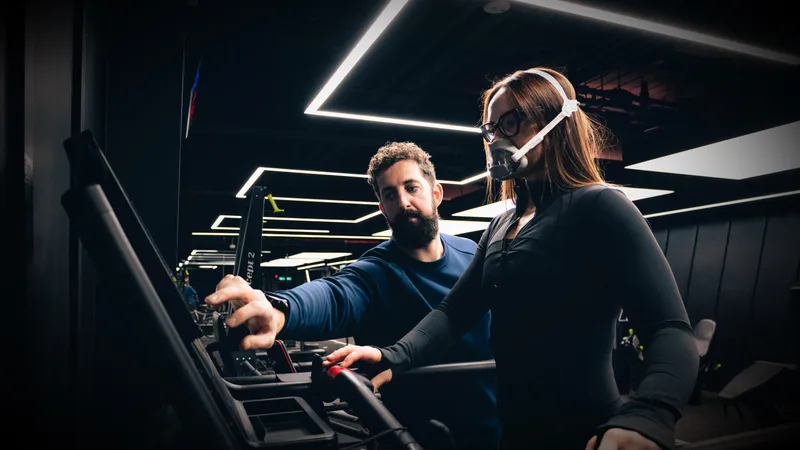
Every 6 months: Repeat the Virtual Longevity Assessment — full re-screen of the six markers that actually matter: blood pressure, grip strength, waist-to-hip ratio, lifestyle factors, functional movement, and resting metabolism + VO2 max via Calibre Biometrics Mask. Major programme direction set on the assessment data.
This rhythm produces compounding gains across 18 to 24 months. The shorter time horizons most clients use for assessing whether training is “working” (6 weeks, 12 weeks) often miss the curve — month 3 looks like slow progress, month 12 looks like compounding progress, month 24 looks like a meaningfully different body capacity.
The equipment question
The most common objection to online coaching is “I don’t have the right equipment”. The honest pattern: most over-50 clients already have everything they need — they just don’t know it yet.
A meaningful structured programme can be designed for:
- Bodyweight only (no equipment) — viable for 4 to 8-week blocks, particularly during heavy travel periods
- Bodyweight + 1 resistance band — adds enough loading variance for sustainable progressive overload
- Adjustable dumbbells + a bench — covers 80% of what most clients need long-term
- Full home gym (rack, bar, plates) — opens the full compound-lift catalogue
- Commercial gym membership — same as home gym, plus more equipment
The right home setup is the cheapest one that supports the patient’s actual training. Spending £3,000 on a home gym before establishing whether the patient will train consistently is a common waste. A pair of adjustable dumbbells + a band + a doorway pull-up bar is enough to run 12 months of structured programming for most patients. The home gym comes later, after consistency is established.
What changes in 6 to 12 months of online coaching
For a typical 50-year-old senior professional starting from a moderately active but inconsistently-trained baseline, with structured online coaching across 6 to 12 months:
- Lift progression of 25 to 50% on the main compound movements
- Resting heart rate drop of 5 to 10 bpm with paired Zone 2 work
- Sleep quality improvement reported by 70%+ of clients
- Body composition modestly improved at constant scale weight
- Subjective energy through the working day — typically the change clients notice most
- Hitting the 50/50 Standard on at least 4 of the 6 markers by month 12 for most patients
What does not change: dramatic body composition shifts inside the first 3 months. The body recomposes before the scale moves. Online clients who track only the scale tend to abandon the programme prematurely; clients who track the lifts, the resting heart rate, and the subjective energy stay engaged through the slower visible-change months.
Cost vs. value
Online coaching with structured assessment-led programming sits between subscription apps (£10–£20/month, no individual design) and 1-to-1 in-person coaching (£780 to £2,880 per pack). The price point — £299 setup for the Virtual Longevity Assessment, then £299/month for the programme + check-ins + review calls — reflects the difference: individual programme design, real coach oversight, monthly re-calibration.
For a frequent traveller or out-of-London client, online is often the better-value option overall. For a London-based client who can reliably train at UNTIL Bishops Square 1 to 2 times a week, in-person is often the better value. The right starting point is the Longevity Assessment (in-person) or the Virtual Longevity Assessment (remote) — both produce the data that makes the format choice obvious.