The direct answer
A movement assessment is a structured 60 to 90-minute evaluation of how the body moves through the fundamental patterns — squat, hinge, push, pull, rotate, single-leg balance — to identify the limitations, asymmetries, and compensations the body has been quietly working around. The output is a written Results Review with a personalised training-pathway recommendation. For City professionals over 45 who train consistently but are not progressing, who are returning after a long gap, or who have a history of injury, the structured assessment is the difference between guessing at the right next step and knowing it.
Why most City professionals need one
The pattern at UNTIL Bishops Square is consistent. Senior professionals arrive with one of three presentations:
- “I train regularly but I’m not getting anywhere.” Three sessions a week for two years, lifts plateaued for the last twelve months, energy lower than it should be. The assessment usually reveals a single dominant limitation (most commonly restricted thoracic extension, occasionally restricted ankle dorsiflexion, sometimes both) that is constraining every compound lift. Address the limitation, the lifts start moving again.
- “I want to come back to training after a long gap.” Lifted seriously in their twenties, drifted off in their thirties and forties, now at 50 with a body that has changed. The instinct is to start where they left off; the assessment shows where they actually are. The right starting point is usually slower and more structured than the patient expects.
- “I’ve had X injury, and I want to train without it getting worse.” Lower-back episode, shoulder impingement, knee arthroscopy, hip replacement. The assessment identifies the compensations still present from the injury and structures the training around them. Generic gym programming usually retraumatises the affected joint; structured assessment-led programming works around it and rebuilds capacity safely.
In all three cases, the failure mode of skipping the assessment is the same: time spent training the wrong things at the wrong load, six months in, the patient concludes that training “isn’t working” — and stops.
The six markers that actually matter
Matt’s own description of the assessment, verbatim from his clinic practice:
I track the metrics that actually matter:
- Blood Pressure
- Grip Strength
- Waist-to-Hip Ratio
- Lifestyle Factors
- Functional Movement
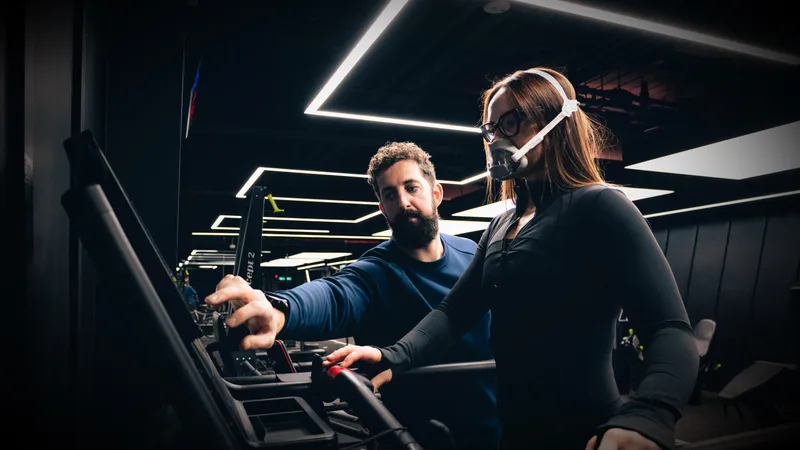
- Resting Metabolism & VO2 Max with a Calibre Biometrics Mask
No gimmicks. No guesswork. Just clarity on where you are and a plan to improve every marker that impacts how long and how well you live.
Each of these six markers maps to a different longevity-relevant capacity. The structured movement screen below sits underneath the Functional Movement marker, but is interpreted alongside the other five — a body with strong functional movement and poor cardiovascular reserve has a different programming priority than one with strong reserve but compensating movement patterns.
What gets measured
The complete movement assessment combines several established frameworks:
Functional Movement Screen (FMS)
The most widely-used clinical movement screen, developed by Gray Cook. Seven patterns, each scored 0 to 3:
- Deep squat — bilateral lower-body mobility, posterior chain
- Hurdle step — single-leg stance + dynamic stability
- In-line lunge — split-stance balance + asymmetry detection
- Shoulder mobility — combined glenohumeral + scapulothoracic range
- Active straight leg raise — hamstring flexibility + hip stability
- Trunk stability press-up — core stability under closed-chain load
- Rotary stability — multiplanar trunk control
Total score out of 21. The clinical literature on FMS as a predictor of injury risk is mixed (the original claim was overstated; the actual evidence is more nuanced). What FMS reliably does surface is asymmetries and compensations — patterns where the right and left sides move differently, or where the patient is unable to perform the pattern at all. Those are the targeted-correction priorities.
Capacity testing
Beyond the movement screen, the assessment measures:
- Hip mobility — flexion, extension, internal rotation. Most desk-based 50-year-olds are well below age-appropriate range.
- Ankle dorsiflexion — measured with a knee-to-wall test. Restricted ankle dorsiflexion is the silent cause of many squat-pattern problems.
- Thoracic extension — the upper-back position. The desk-job thoracic kyphosis is one of the most common patterns the screen identifies.
- Single-leg balance — open-eye and closed-eye. Often a surprise for patients in their fifties who haven’t trained balance specifically.
- Grip strength — hand dynamometer. Single best published correlate of all-cause mortality and functional independence after 60.
Movement history + lifestyle review
The screen data is interpreted alongside the patient’s training history (what they have done before, what has worked, what has injured them), occupational demands (desk hours, travel patterns), sleep, stress, recovery habits, and any current medications or clinical conditions relevant to training.
A 50-year-old with a 50-hour desk job, two children, average sleep, and a prior back episode is a different programming problem from a 50-year-old who works from home, sleeps 8 hours, and has never been injured. Same lifts; different programme.
The output
Every structured movement assessment produces a written Results Review containing:
- Movement summary — what the screen found, scored against age-appropriate norms
- Capacity baselines — the specific numbers (mobility range, strength, balance) that programming will track against
- Limitation priorities — the 2 to 4 specific patterns that should be addressed first before load is progressed
- Recommended training pathway — which coaching format (1-to-1, online, self-led) fits the patient’s life and goals
- Programme starting point — the actual first 4 to 6 weeks of training, structured around the limitations identified
The Results Review is yours to keep regardless of whether you continue with coaching. Some clients use it as a one-off audit and continue training independently; others use it as the structured entry point into a coaching pathway.
What a movement assessment is not
It is not a clinical diagnosis. A structured screen identifies the patterns most associated with adult back, hip, knee, and shoulder pain — but identifying the patterns is not the same as diagnosing the underlying tissue or joint condition. If the screen finds red flags (radiating leg pain, neurological symptoms, recent trauma, suspected pathology), the assessment ends with a referral recommendation — physiotherapy, GP, or sports medicine consultant depending on the presentation. The coach’s job at that point is to route the patient to clinical care, not to treat a condition outside the scope of strength coaching.
It is not a fitness test. The point is movement quality and limitation identification, not measuring how hard the patient can push. The screen is conducted at sub-maximal loads, with adjustments for current ability, and is appropriate for patients who have never trained as well as patients with significant athletic backgrounds.
It is not a sales call. The Longevity Assessment is a paid product (£299) with a written deliverable. The structured 90 to 120 minutes is the assessment, not a conversion conversation. Some clients book and never continue with coaching; that is a successful outcome of the product working as designed.
Who is doing the assessment
The structured assessment is conducted by Matt Alexander — a UKSCA-accredited Strength and Conditioning Coach with a BSc in Strength & Conditioning Science (Outstanding Academic Achievement Award in Biomechanics, on research into elite rowing biomechanics), Precision Nutrition Level 2 certification, and twelve years of practice with senior professional clients in the City of London.
The credentials matter for the assessment specifically because the FMS and movement-screening literature is part of the published S&C body of knowledge — it is not generic gym training. A coach without the underlying education can administer the screen mechanically but is less likely to interpret the data correctly or to translate the findings into a programme that respects the patient’s specific constraints.
How the assessment leads into training
The Results Review is designed to make the next training block obvious. If the screen identified restricted thoracic extension as the dominant limitation, the first 4 to 6 weeks focuses on mobility work in that pattern before any heavy overhead loading is added. If the screen identified weak posterior chain alongside tight hip flexors (the classic desk-job pattern), the programming starts with hip-dominant patterning and corrective work.
The patient chooses which coaching format fits — 1-to-1 in-person, online coaching, or the self-led programme. All three start from the same baseline data; the differences are the level of ongoing oversight and adjustment. Many clients move between formats over time depending on travel patterns and life stage. The assessment data persists; the format adapts.