The direct answer
The 50/50 Standard is a six-marker benchmarking framework for men around age 50 — a baseline set of strength, mobility, and cardiovascular targets that indicates whether the body is built to hold up across the next two decades. Hitting the standard is not the training goal; it is the resilience floor. Falling well below any single marker is a clear priority signal for the next training block.
The six markers:
| Marker | Target |
|---|---|
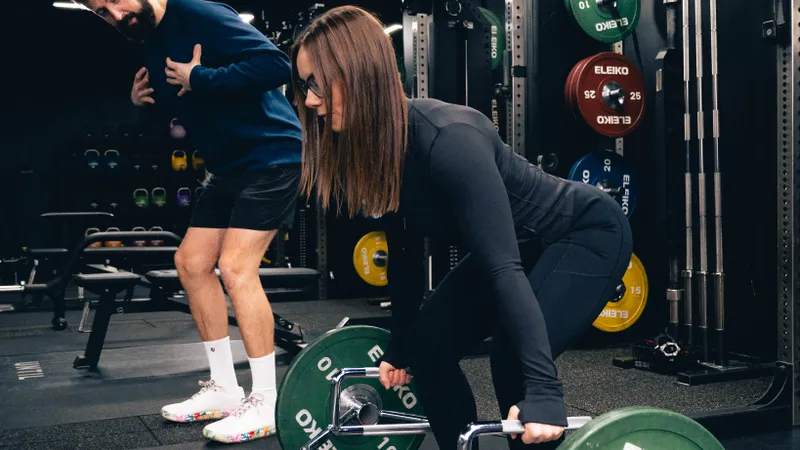
| Deadlift | Bodyweight for 5 reps |
| Back squat | 0.75x bodyweight for 5 reps |
| Overhead press | 0.5x bodyweight for 5 reps |
| Farmer carry | Bodyweight (50% per hand) for 60 metres |
| Full-range squat-to-stand | No hand support |
| VO2 max | 40 ml/kg/min |
The broader assessment context
The 50/50 Standard sits inside Matt’s wider assessment framework — the six markers that actually matter, in his own words:
- Blood Pressure
- Grip Strength
- Waist-to-Hip Ratio
- Lifestyle Factors
- Functional Movement
- Resting Metabolism & VO2 Max with a Calibre Biometrics Mask
No gimmicks. No guesswork. Just clarity on where you are and a plan to improve every marker that impacts how long and how well you live.
The 50/50 Standard is the strength layer of this broader assessment — the specific load-based benchmarks (deadlift, squat, press, carry, mobility, cardiovascular) that sit alongside the metabolic, vascular, and lifestyle markers. A complete picture comes from both: the strength data tells you what the body can do; the metabolic and lifestyle data tells you whether that capacity is sustainable across the next two decades.
Why six markers, not one
A single strength number — say, a 100 kg deadlift — describes one capacity in isolation. Capable independence at 60, 70, and 80 is not a single capacity. It is the combined output of structural strength, mobility, balance, and cardiovascular reserve, with each pillar capable of independent failure. A man who can deadlift 200 kg but cannot squat-to-stand without grabbing the chair has solved one problem and ignored two others. The 50/50 Standard exists to make the gap visible before it becomes the limiting factor in daily life.
Each marker maps to a distinct longevity-relevant capacity:
- Deadlift bodyweight — posterior chain integrity, hip-dominant patterning, and the ability to pick up your own weight from the floor at 75.
- Back squat 0.75x — knee, hip, and ankle range under load. The strongest published predictor of independent function after 70.
- Overhead press 0.5x — shoulder integrity and thoracic mobility. The bedrock of lifting grandchildren overhead at 65.
- Farmer carry bodyweight — grip strength has one of the strongest published correlations with all-cause mortality after age 50. It is also one of the easiest markers to train.
- Squat-to-stand — combined hip mobility, ankle dorsiflexion, and balance. The test most adults fail by their forties without realising.
- VO2 max 40 ml/kg/min — cardiovascular reserve. The difference between feeling 40 and feeling 60 in the third hour of a long day.
Hitting the standard is not the goal
A common mistake is to treat the 50/50 Standard as a target — a number to chase. It is not. It is a baseline for resilience, not an aspiration. Clients who exceed the standard comfortably within 12 months should not keep chasing higher numbers without a clear reason. Beyond the baseline, the diminishing returns of pushing harder become obvious — the injury risk climbs faster than the benefit.
The right relationship to the standard is:
- Measure where you are at the start of training.
- Identify the underperforming markers — those become the priorities.
- Train to the standard, not past it.
- Re-test every 6 to 12 months to confirm the markers are holding.
Once the standard is comfortably held, training shifts focus to maintenance + life-application strength — being capable of the activities and recovery demands of senior work, parenting, sport, and travel. The standard is the floor; the ceiling is whatever the patient actually wants to do with their body across the next two decades.
What falling below each marker means
Below the deadlift standard: the posterior chain is the priority. Start with structured hinge patterning (RDLs, single-leg RDLs, kettlebell swings) before progressing to a full deadlift load. Most adult back pain responds well to this work; ignoring it is the root cause of the back pain in the first place.
Below the squat standard: lower-body strength + hip mobility are the priorities. The squat is the cleanest test of whether the knee, hip, and ankle joints work together under load. A failed squat usually points at one of the three — programming should start with the limiting joint, not the lift.
Below the overhead press standard: thoracic mobility precedes load. Most adults who fail the overhead press do so because they cannot achieve a clean overhead position, not because the shoulder lacks strength. Mobility work — wall slides, foam-roller thoracic extensions, banded pull-aparts — is the first 4 to 6 weeks of programming.
Below the farmer carry standard: grip is the priority and is easy to train. Two sessions a week of progressive carries (start at 75% bodyweight, add load weekly) closes most grip-strength gaps inside 8 to 12 weeks. The return on this investment is disproportionate to the time spent.
Below the squat-to-stand standard: mobility precedes everything. Hip flexors, ankle dorsiflexion, and thoracic extension all contribute. Daily 5-minute mobility blocks compound faster than people expect — most clients clear this marker inside 6 weeks once they actually start doing the work.
Below the VO2 max standard: structured aerobic work needs to be added alongside strength training. Most City professionals are well below their potential VO2 max simply because they have never trained it. Two sessions of 30 to 40-minute Zone 2 work per week, plus one shorter Zone 4 session, produces measurable improvements inside 8 weeks.
Where the framework comes from
The standard is informed by published longevity, mortality, and functional-independence research — Peter Attia’s work on Centenarian Decathlon training, the literature on grip-strength mortality correlation (notably the PURE study, 139,000 participants, 17 countries), the published norms for VO2 max by age decile, and the strength-and-conditioning literature on rep-based load benchmarking (Schoenfeld, Helms). The specific numbers were chosen for capable independence at 75, not elite athleticism — they sit at the floor, not the ceiling.
The standard was developed in practice with senior professional clients at UNTIL Bishops Square over twelve years of coaching. The pattern that emerged: men who held the markers well at 50 stayed independent and capable through their sixties and seventies; men who fell well below any single marker tended to develop matching functional limitations within five years.
How to test yourself
Most of the markers can be self-tested at a well-equipped gym with a working knowledge of the lifts. Deadlift, squat, and overhead press are simple — pick a load you can complete for five clean reps with two in the tank, then compare to the standard. Farmer carry is a 60-metre walk with the prescribed load. Squat-to-stand is a visual test — full range, no hand support.
VO2 max is the harder marker to self-test. Direct measurement requires gas-analysis equipment (the kind used in a structured Longevity Assessment). A reasonable estimate comes from a structured 12-minute Cooper test (run as far as you can in 12 minutes, then calculate from the published formula). The accuracy is sufficient to identify whether you are clearly above, at, or below the 40 ml/kg/min target — not for elite-level precision.
If self-testing isn’t structured enough for your taste, every Longevity Assessment at UNTIL Bishops Square measures all six markers in 90 to 120 minutes, plus the lifestyle, recovery, and movement-quality context that informs the next training block.